Detail Actuating Devices For HVAC And Industrial Plants
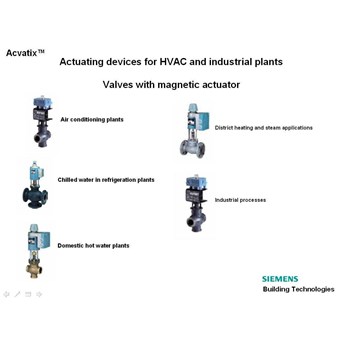
Actuating devices for HVAC and industrial plants
Valves with magnetic actuator
The functioning principle of magnetic control valves is simple: Modulating voltage is applied to a coil. The voltage pushes the metal core inside the coil against a spring, positioning the core as a function of voltage. This makes possible very fast and accurate control changes without practically causing wear and tear. Since magnetic drives produce relatively small positioning forces in comparison with electromotoric or electrohydraulic actuators, magnetic control valves are equipped with a pressure-compensating system. Hence, the magnetic positioning force and thus the amount of energy needed are only small.
An important design detail is the flexible valve plug which enables the valve to open without the typical inlet jump known from conventional control valves. This allows very accurate control of small loads.
The benefits
1. Short positioning time (1 second)
2. Highest resolution (1:1000)
3. Opening without inlet jump
4. Perfect low load control
5. Accurate valve characteristic and positioning control
The features at a glance
1. 2-port- and 3-port applications
2. Selectable valve characteristic (equal-percentage and linear)
3. Flanged and threaded connections
4. Closed when deenergized
Air conditioning plants
Energy savings in ventilation plants thanks to improved part load behavior
Due to outdoor climate changes the proportion of the number of operating hours in which ventilation and air conditioning plant need to operate under part load conditions increases. As a result, the previous boundaries between typical winter and summer operation tend to fade. So it occurs more and more often that cooling is required in the winter also, or during intermediate seasons. With a more accurate control of temperature and humidity energy savings of up to 30 percent is possible. Since “part load situations“ occur more and more frequently while cooling costs rise over-proportionally, it is worth the effort to check the control loops and to readjust the operating parameters. In view of improved control performance, it is often economical to substitute conventional control valves by magnetic control valves.
Chilled water in refrigeration plants
Optimally controlled chilled water cycles
In contrast to heating plants where temperature control is rather simple, chilled water installations require a more sophisticated control system. Large mass volumes with small temperature differentials call for large and fast-reacting valves. Pressure-compensated magnetic valves have kVS values of up to 130 m3/h and a positioning time of less than 3 seconds with a resolution of 1:1000 and are therefore many times faster and more accurate than any other types of valves.
Domestic hot water plants
DHW heating in instantaneous heating systems
In DHW heating plants also, fast-acting instantaneous flow systems with plate heat exchangers increasingly replace the former large storage systems. The driving force behind this development are more stringent hygienic regulations aimed at reducing the risk of legionella viruses, and the efforts made to eliminate the heat losses resulting from large and therefore slow systems. Small storage tanks are only used as buffers to cover peak loads. Due to the heat transmission characteristics of plate heat exchangers, very short valve positioning times are absolutely essential. Magnetic control valves with a positioning time of 1 second guarantee a perfect control performance.
District heating and steam applications
Space-saving solutions for district heating plants
In the case of small or medium plant capacities, premanufactured compact district heat substations are used more and more frequently. Since heat transmission in these compact exchangers is considerably quicker, the controlled systems must also become faster. Where, previously, motorized valves with positioning times of 15 to 30 seconds were adequate to handle the large volumetric flows of the counter-flow units, today’s plate heat exchangers with their small volumetric flows and large heat exchange surfaces demand very fast-acting valves with short positioning times. Positioning times of a few seconds are considered ideal, but such short times can practically only be attained when employing magnetic valves.
Industrial processes
Innovations thanks to better control performance
A large number of today’s innovations in the industrial sector are based on manufacturing procedures taking place under well-defined environmental conditions, be it the production of machines, semiconductors, foodstuff or medicine. While years ago temperature accuracies within a few tenths of a degree Kelvin were sufficient, proportional magnetic valves can offer accuracies in the area of a few thousandth of a degree Kelvin.
Tampilkan Lebih Banyak